
Recent advances in motion capture have made it more affordable and user-friendly for indie filmmakers like you. Portable, wireless sensors and real-time recording devices allow you to capture actor performances with minimal equipment and cost. Sophisticated software now helps you easily integrate and refine virtual characters, reducing post-production hours. These developments empower you to create realistic, emotionally compelling visuals without Hollywood-sized budgets, opening new storytelling possibilities. Keep exploring to discover how these innovations can elevate your projects even further.

Get movie nights delivered free with Prime
- Fast, free delivery on millions of items
- Prime Video, Amazon Music and more included
- Member-only deals all year
Key Takeaways
- Affordable, portable motion capture systems enable indie filmmakers to create realistic virtual characters without high costs.
- Real-time performance capture allows quick visualization and iteration, streamlining indie project workflows.
- User-friendly software facilitates seamless integration and fine-tuning of character movements, expressions, and lip-sync.
- Advances eliminate the need for extensive post-production, reducing time and expenses for independent filmmakers.
- Enhanced realism and emotional depth in virtual characters help indie films compete with larger studio productions.

For indie filmmakers looking to bring their creative visions to life, motion capture has become an accessible and cost-effective tool. Thanks to recent advances, you can now craft virtual characters that feel authentic and alive without breaking the bank. Performance capture technology allows you to record an actor’s movements and expressions directly onto a digital model, giving you a high level of realism and emotional depth. This process bridges the gap between traditional animation and live-action filmmaking, enabling you to create complex characters with fewer resources.
Motion capture makes creating realistic, emotionally rich virtual characters affordable and accessible for indie filmmakers.
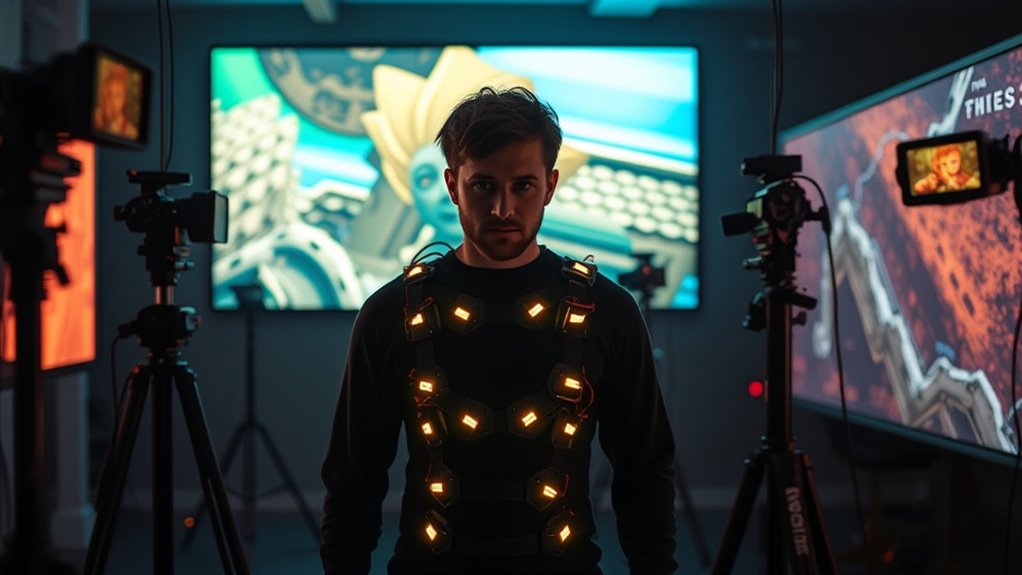
One of the biggest breakthroughs has been the development of more affordable and user-friendly motion capture systems. Previously, high-end setups required substantial equipment, dedicated studios, and specialized personnel. Today, many indie filmmakers can access portable, wireless sensors that attach easily to actors, capturing their performance in real time. These systems often connect to your computer or tablet, making it straightforward to integrate performance capture into your workflow. The result is a virtual character that accurately reflects the actor’s nuanced movements, facial expressions, and even subtle gestures, adding a layer of depth that’s often missing in traditional CGI.
The evolution of performance capture technology also means you don’t need a large crew or extensive training to get started. Many solutions come with intuitive interfaces and real-time visualization, allowing you to see your virtual character come to life on screen immediately. This immediacy accelerates your creative process, enabling rapid iteration and experimentation. You can film an actor performing complex actions—like combat scenes, dance routines, or emotional monologues—and see the results instantly, making adjustments on the fly. This efficiency lowers costs and reduces the need for extensive post-production, which is a game-changer for independent filmmakers working with limited budgets.
Moreover, advances in software now enable smoother integration of performance capture data with animation tools. You can easily refine your virtual character’s movements, facial expressions, and lip-sync to match your vision perfectly. These tools often come with presets and AI-assisted features that help clean up any inconsistencies, saving you hours of manual editing. The ability to animate virtual characters through performance capture opens new storytelling possibilities, allowing your characters to behave naturally and convincingly within your narrative.
In short, recent developments in motion capture technology have democratized the process, making it more accessible and practical for indie filmmakers. You no longer need a Hollywood-sized budget or studio to craft believable, emotionally resonant virtual characters. Instead, you can leverage cutting-edge performance capture solutions to bring your ideas to life with authenticity and precision, giving your projects a professional edge that captivates audiences.
Frequently Asked Questions
What Are the Initial Costs of Implementing Motion Capture Technology?
The initial costs of implementing motion capture can vary widely, but you should plan for a sizable investment. You’ll need to budget for equipment like cameras, suits, and sensors, which can range from a few thousand to tens of thousands of dollars. Additionally, consider software licenses and setup fees. Budget considerations are vital, but advancements now make motion capture more accessible for indie filmmakers seeking to integrate this technology effectively.
How Can Indie Filmmakers Access Affordable Motion Capture Equipment?
You can turn motion capture into a playground rather than a costly jungle by exploring budget-friendly techniques and debunking motion capture myths. Use affordable options like smartphone-based systems or open-source software, which act like hidden gems waiting to be discovered. Many indie filmmakers share tips online, showing you how to access quality tools without breaking the bank. With a little creativity, motion capture becomes an accessible tool, not a distant dream.
What Software Options Are Best for Independent Motion Capture Projects?
You should consider software like iPi Motion Capture, which offers affordable options for virtual characters and facial tracking. Blender is also a great free choice, supporting motion capture data integration and detailed facial animation. Adobe Character Animator provides real-time facial tracking for virtual characters, making it ideal for indie projects. These tools are user-friendly and cost-effective, helping you bring your motion capture ideas to life without breaking the bank.
How Can Indie Filmmakers Overcome Technical Challenges in Motion Capture?
You can overcome technical challenges by focusing on facial expression capture and utilizing real-time feedback. Use affordable, user-friendly motion capture software that offers instant visualizations, so you can quickly identify and rectify issues. Invest in proper calibration and lighting, and practice with your setup regularly. These steps help guarantee smoother captures, better character expressions, and more efficient workflows, making high-quality indie films more achievable.
What Are the Best Practices for Integrating Motion Capture Into Low-Budget Films?
To integrate motion capture into your low-budget film effectively, focus on simple character design that’s easy to animate. Use affordable mocap technology and plan your scenes for seamless storytelling integration, ensuring the captured movements enhance your narrative. Collaborate with skilled animators and shoot in controlled environments to minimize technical issues. Keep your scope manageable, and prioritize storytelling to make your motion capture work compelling and cost-efficient.
Conclusion
Embracing motion capture technology gently opens new doors for indie filmmakers, allowing you to explore creative horizons that once seemed just out of reach. While it might seem like a small step, it’s actually a quiet leap toward transforming your storytelling potential. With each subtle improvement, you’re nurturing your craft, quietly building a more immersive world for your audience. So, don’t underestimate these gentle advancements—they might just be the whisper of change your projects need.
Fall Picks
fall essentials
As an affiliate, we earn on qualifying purchases.