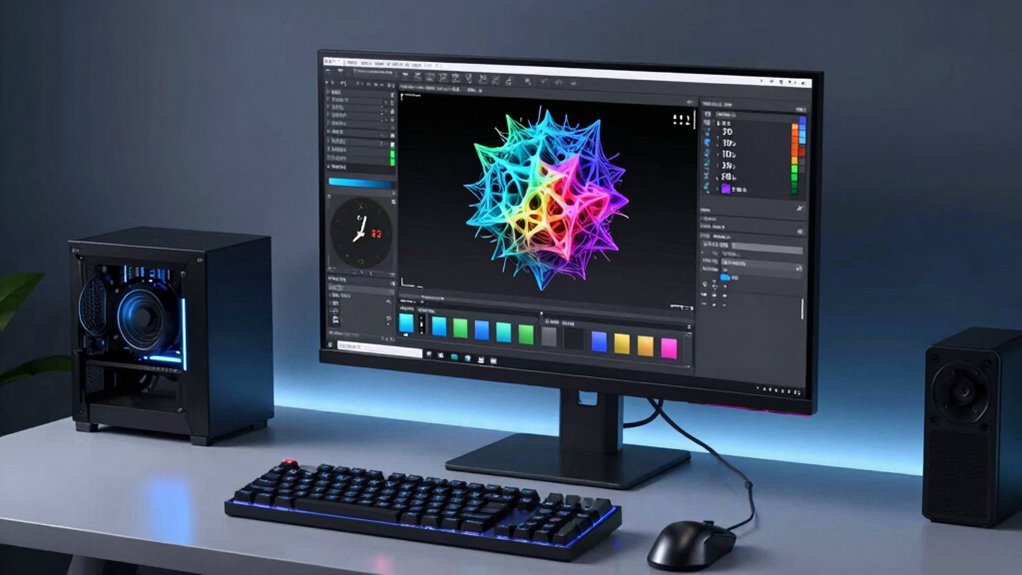

Choosing the right hardware and optimizing your software setup directly impacts your render times and revision speed. Compatible components like a powerful GPU, ample RAM, and fast storage work together to eliminate bottlenecks and guarantee smooth workflows. Keeping software updated and properly configured maximizes hardware benefits. Future-proofing your system with upgradability also helps maintain performance over time. Stay with us to discover how aligning hardware and software can boost your productivity even further.
Key Takeaways
- High-performance GPUs and ample RAM reduce rendering times and enable faster revisions.
- Compatible, up-to-date hardware and software optimize workflow efficiency and minimize technical delays.
- Upgradable systems allow adaptation to evolving software demands, maintaining fast render and revision speeds.
- Proper hardware-software configuration prevents conflicts, crashes, and slow processing during intensive tasks.
- Balanced hardware choices ensure smooth rendering, quick revisions, and overall increased productivity.
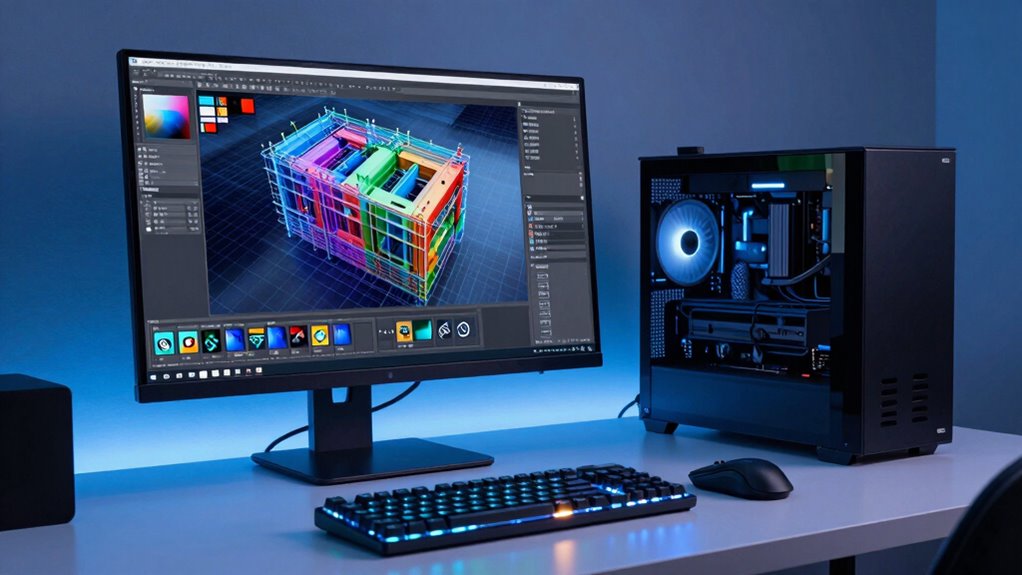
Choosing the right computer can considerably impact your rendering time and revision speed, especially when working on complex projects. When you prioritize hardware compatibility, you’re ensuring that your machine’s components work seamlessly together, which directly influences how efficiently rendering tasks are completed. A computer with compatible hardware—such as a high-performance GPU, ample RAM, and fast storage—reduces bottlenecks during intensive processes. If your hardware isn’t compatible or is outdated, you’ll find yourself waiting longer for renders to finish, and revisions may become frustratingly slow. Guaranteeing compatibility means selecting a system where the CPU, GPU, memory, and storage work in harmony, minimizing delays and maximizing productivity.
Prioritizing hardware compatibility ensures seamless workflows and faster rendering and revisions.
Alongside hardware compatibility, software optimization plays a vital role. When your computer’s hardware is well-matched to the software you’re using, rendering and revision workflows become much smoother. Software optimization involves the program making the best use of your hardware’s capabilities, which can be achieved through updated drivers, properly configured settings, and leveraging hardware acceleration features. If your software isn’t optimized for your hardware, you’ll likely experience lag, crashes, or slow processing, even with high-end components. For instance, many rendering programs can utilize GPU acceleration—if your GPU is supported and your software is configured correctly, rendering times drop markedly. Conversely, ignoring software optimization can negate the benefits of powerful hardware, leading to inefficient workflows and extended revision cycles. Proper hardware configuration can significantly enhance overall performance and stability. Additionally, maintaining hardware-software compatibility can prevent unexpected conflicts that hinder your workflow. Ensuring that your hardware is compatible with the latest software updates can also help avoid unexpected performance issues, which can be costly in terms of time and effort.
Your choice of a computer should also factor in how easily you can upgrade or customize it. Systems designed with future-proofing in mind allow you to swap out components like graphics cards or add more RAM, keeping your setup aligned with evolving software demands. This flexibility ensures your hardware remains compatible with new updates or plugins, maintaining peak performance over time. Additionally, selecting a machine with robust cooling and power supply prevents overheating and power issues, which can throttle hardware performance and slow down your workflow.
Furthermore, understanding the importance of hardware compatibility can help you avoid potential compatibility issues that disrupt your workflow. Ultimately, the way your computer handles hardware compatibility and software optimization directly shapes your productivity. A well-balanced system allows for rapid rendering, faster revisions, and less downtime, enabling you to focus more on your creative process than on technical hiccups. Investing in compatible, optimized hardware and software creates a synergy that accelerates your work, making complex projects more manageable and less time-consuming. It’s not just about having powerful components but ensuring they work together efficiently—because in digital creation, harmony between hardware and software is fundamental to speeding up your entire workflow.
high performance GPU for rendering
As an affiliate, we earn on qualifying purchases.
As an affiliate, we earn on qualifying purchases.
Frequently Asked Questions
How Does GPU vs. CPU Impact Rendering Performance?
Using a GPU for graphics rendering offers considerably faster processing power compared to a CPU, especially for complex visuals and real-time tasks. You’ll notice quicker render times and smoother revisions because GPUs are optimized for parallel processing. While CPUs handle general tasks well, they can’t match GPUs’ specialized architecture for graphics rendering. So, if speed matters, investing in a powerful GPU directly enhances your processing power and overall rendering performance.
What Role Does RAM Size Play in Revision Speed?
You might not realize, but having at least 16GB of RAM can substantially boost your revision speed. Memory bottlenecks often cause delays as your system struggles to manage large files, forcing it to use swap files, which slows everything down. Increasing RAM reduces reliance on swap files, enabling smoother workflows and quicker revisions. So, a larger RAM size directly improves your efficiency by minimizing these bottlenecks.
Do Storage Types Affect Render Times Significantly?
Storage types can considerably impact render times, especially if you face storage bottlenecks. Faster SSDs reduce data transfer times compared to traditional HDDs, allowing your computer to access and process files more quickly. This means less waiting and smoother workflow. Upgrading to a high-speed storage solution can improve overall rendering efficiency, especially when working with large files or complex projects that demand rapid data access and transfer speeds.
How Do Hardware Upgrades Influence Long-Term Productivity?
You’ll find that hardware upgrades can turn your sluggish workflow into a sleek, turbo-charged machine—if you dodge upgrade bottlenecks and guarantee hardware compatibility. Upgrading your computer boosts productivity by reducing render times and speeding up revisions, but only if components work harmoniously. Ignoring bottlenecks or incompatible parts leaves you stuck in upgrade limbo, making future improvements a frustrating game of hardware whack-a-mole instead of a smooth upgrade journey.
Can Software Optimizations Outweigh Hardware Improvements?
Yes, software optimizations can sometimes outweigh hardware improvements, especially when addressing software bottlenecks. By applying optimization techniques like code refactoring, efficient algorithms, and resource management, you can considerably boost render times and revision speed without costly hardware upgrades. These improvements make your existing system more efficient, often providing faster returns than hardware investments alone, and allow you to maximize your current setup’s potential.
16GB RAM for video editing
As an affiliate, we earn on qualifying purchases.
As an affiliate, we earn on qualifying purchases.
Conclusion
Choosing the right computer isn’t just a small decision—it’s like holding the key to a rocket ship that can launch your creativity into orbit in seconds. Your hardware choices directly impact how quickly you see your ideas come to life and how effortlessly you can make revisions. With the perfect setup, you’ll breeze through rendering and editing, transforming your workflow from a sluggish crawl into a lightning-fast race. So, pick wisely—your creative universe depends on it!
fast SSD storage drive
As an affiliate, we earn on qualifying purchases.
As an affiliate, we earn on qualifying purchases.
upgradable desktop computer for creative work
As an affiliate, we earn on qualifying purchases.
As an affiliate, we earn on qualifying purchases.