
Get movie nights delivered free with Prime
- Fast, free delivery on millions of items
- Prime Video, Amazon Music and more included
- Member-only deals all year
Step into the Shadowy Skies of Night Rotors
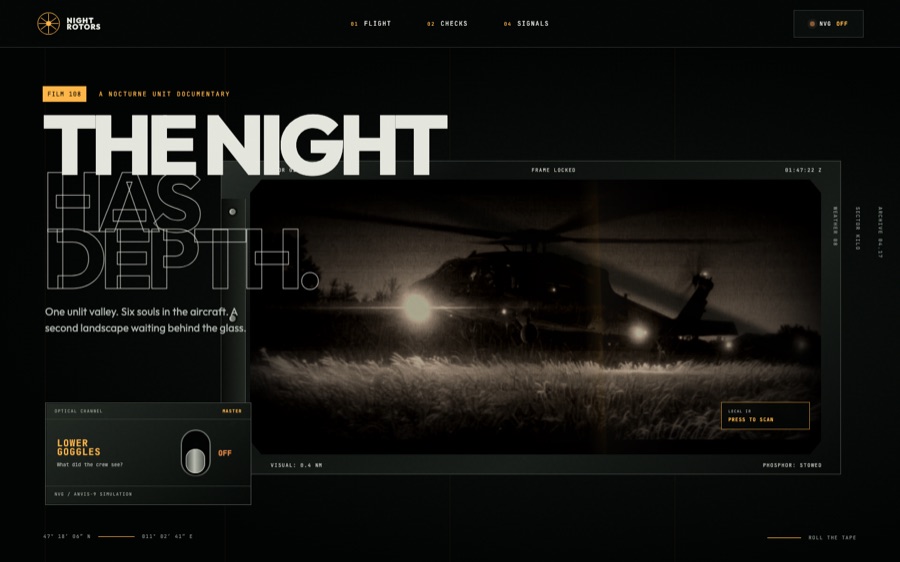
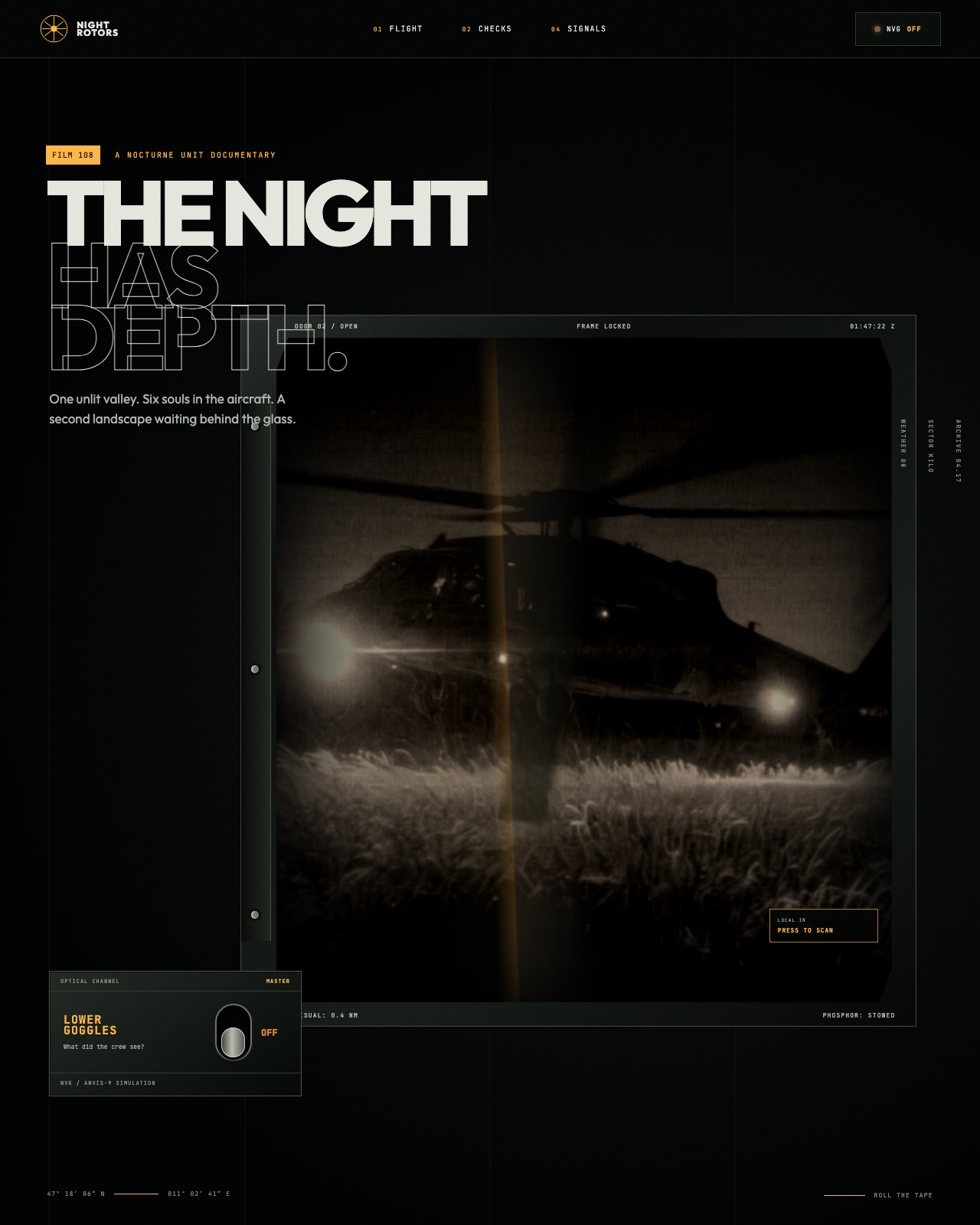
Imagine a digital space that immerses visitors in a nocturnal rescue mission, where every visual element mimics the fleeting, incomplete sight of night-time aviation. This site, crafted entirely by AI, transforms the familiar into an atmospheric experience that blurs the line between documentary and fiction. Its signature feature? A tactile toggle that shifts between visible light and hidden infrared layers, revealing secrets behind phosphor glass that are normally concealed from the naked eye. This dynamic switch isn’t just a visual effect—it’s the core of the site’s storytelling technique, offering viewers a glimpse into unseen realities.
Dissecting the Visual and Interaction Layers
The site’s striking aesthetic hinges on a carefully curated palette—deep blacks, glowing greens, and amber hues evoke the mysterious world of night flight. Typography is compact and precise, echoing the technical nature of aviation instruments, while subtle grain and motion effects simulate the flickering and drift of rotor blades in darkness. The centerpiece is a sophisticated toggle control that, when activated, regrades the entire interface from a pale, paper-like appearance into a glowing phosphor display. This switch is implemented through a single class toggle affecting multiple system layers—changing themes, revealing infrared data, and intensifying grain—all in a staged, cinematic manner. The interaction is smooth and staged by CSS clip-paths and transitions, creating a blooming phosphor tube effect that immerses users into the scene’s nocturnal atmosphere.
Building the Experience — From Concept to Certification
The creation process begins with a conceptual vision: blending night-flight visuals with interactive data layers. The site is built in three passes—initial assembly of visual assets and interaction mechanics, a rigorous critique focusing on atmospheric coherence and technical precision, and finally, certification by an art director to ensure it communicates its narrative effectively. Guided by this approach, the AI meticulously constructs layered visual states, synchronized controls, and cinematic motion—culminating in a seamless, immersive experience that invites users to explore hidden layers of night flight through tactile interaction.
The full build notes live in the room’s design guide.
Want this? Paste this into your AI coding agent
Build a single-page showcase website from this art-direction brief. Work like an elite creative frontend engineer; commit totally to the direction.
BRIEF (room 108 of 175, “nightrotors”):
NIGHT ROTORS — a helicopter night-ops unit, fictional documentary. Aesthetic: night vision green + rotor rhythm. Palette: NVG green #7cff9a monochrome sections alternating with true-night black/amber. Fonts: outfit (display), jetbrains-mono (checklists). SIGNATURE: the NVG TOGGLE — flip the goggles (big physical switch) and the ENTIRE page re-renders in green-phosphor mono with bloom, grain and scan noise (CSS filter theater), revealing hidden layers (IR strobes, hot exhaust) invisible in the dark theme; rotor wash bends grass/haze at the page footer continuously; the hero film (helo night loop) sits in a door-gunner frame. Pre-flight checklist that ticks itself, brownout-landing explainer, crew-chief hand signals as pictograms. Unforgettable: everything you missed until you flipped to green.STACK: pure HTML/CSS/JS, no build step, no frameworks, no CDNs or external requests of any kind; self-hosted fonts only; every visual is code (CSS/SVG/canvas/WebGL) — no image assets required.
QUALITY BAR: flawless at 390px, 834px and 1440px with zero horizontal overflow; tap targets >= 44px; semantic landmarks, focus-visible styles, body-text contrast >= 4.5:1; prefers-reduced-motion pauses or simplifies heavy animation; rAF loops pause when the tab is hidden; hold 60fps (cap particle counts, avoid layout thrash); rich invented content everywhere — real-sounding names, numbers and program notes, never lorem ipsum; orchestrate one beautiful staggered load moment plus scroll and hover surprises. FORBIDDEN: Inter/Roboto/Arial/system-ui, purple-gradient-on-white, and cookie-cutter hero+cards+footer layouts.
PROCESS: iterate in three documented passes — (1) build plus builder self-critique, (2) merciless external critique finding and fixing at least ten real problems, (3) art-director elevation from good to unforgettable. Screenshot at all three widths every pass and fix everything you can see.
— Original brief by Claude Fable 5 (art director), executed by the FABLE/175 pipeline.
— This room lives at https://fable-25-830.netlify.app/sites/nightrotors/
This is the verbatim art-direction brief that produced the room — exposed by the exhibition itself via the “Prompt” link in the room’s footer.
Popular right now

Samsung 85-Inch QN70H Neo QLED 4K Smart TV (2026)

TCL T7 Series 85-Inch 4K 144Hz QLED Smart Google TV

TCL QM64L 85-Inch QD-Mini LED 4K Smart Fire TV
As an affiliate, we earn on qualifying purchases.
Explore the Depths of Night Flight
Visit the full Night Rotors exhibition online to experience this AI-crafted digital space firsthand. Dive into all 175 scenes at the project hub and see how innovative interface techniques breathe new life into atmospheric storytelling.
Visit the live room → · Browse all 175 rooms
Previously in Wing V
- Room 102: Flight Deck 0300 — A Night-Launch Documentary
- Room 101: Ghost Division — The Complete Motion Picture Archive
- Room 107: Operation Sandstorm — Field Archive 107
FABLE / 175 is a finished exhibition of 175 fundamentally different websites, each built end-to-end by an AI. This article is part of our series walking through it room by room.