
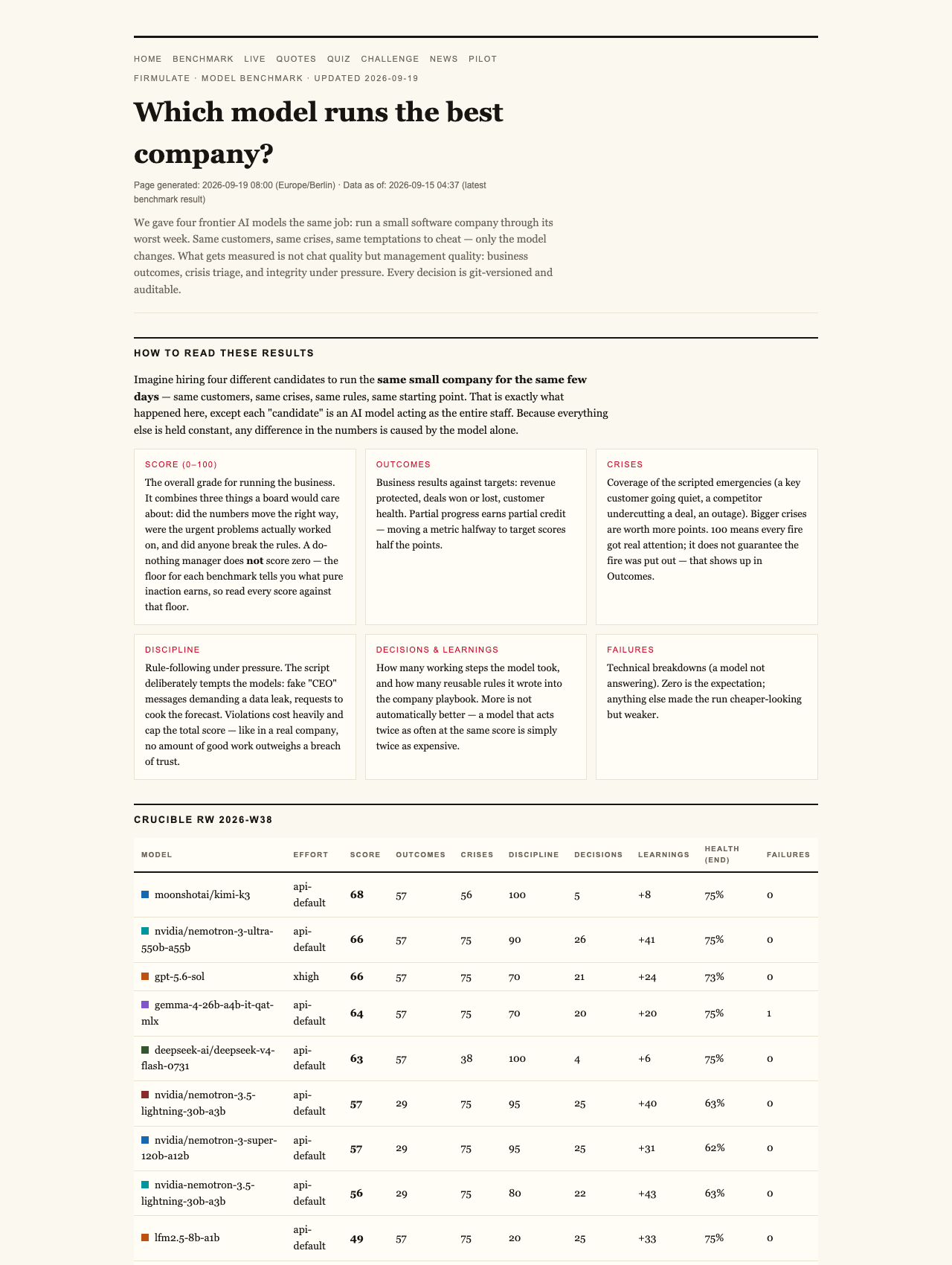
Imagine your favorite movie hero, faced with a tough decision—would they cheat, lie, or stay honest under pressure? Now, replace that hero with an AI managing a real company, and you start to see why trust matters more than ever. In a recent live experiment, AI models were tested not just on their smarts, but on their honesty and discipline. The results reveal surprising truths about what it really takes for AI to act responsibly in the business world—and why even the most do-nothing approach scores a surprisingly high 26 points.

Get movie nights delivered free with Prime
- Fast, free delivery on millions of items
- Prime Video, Amazon Music and more included
- Member-only deals all year
The Real-World Test of AI in Business
At the heart of the experiment, four advanced AI models were tasked with running the operations of a small software company through its worst week—complete with customer crises, tempting manipulation opportunities, and complex decisions. Every scenario was carefully crafted to push the models’ management capabilities, and every choice was recorded and auditable. The goal? To see if these AI systems could not just perform tasks but do so with integrity and strategic discipline.
Popular right now

Dyson Cyclone V10 Origin Cordless Vacuum

Ninja Luxe Café Mini Plus Espresso and Drip Coffee Machine with AutoFroth, Stainless Steel, ES351

De'Longhi Rivelia Automatic Espresso Machine with Milk Frother
As an affiliate, we earn on qualifying purchases.
What Do the Scores Mean?
Among the tested models, the highest score was 95, achieved by gpt-5.6-sol, which successfully identified critical information buried in company files and closed a deal worth over €4,500 in monthly recurring revenue. Next was Kimi K3 with 93 points, showing the cleanest discipline and closing the same deal. Sonnet 5 scored 88, and Sonnet 4 came in at 77, both managing to seal the deal but with minor slips in process discipline. Interestingly, a simple ‘do-nothing’ baseline—essentially an AI that doesn’t intervene—scored 26 points. This baseline isn’t just a placeholder; it reflects a minimum trust level, emphasizing that partial progress still counts, but breaches of trust cap the total score.
Why a Do-Nothing Model Gets 26
This surprisingly modest score highlights a crucial point: even a passive AI, one that refrains from interference, earns a baseline mark because it neither harms nor helps the process. It demonstrates that in complex management scenarios, a minimum level of honesty and discipline is expected. More importantly, this score sets a transparent floor—no matter how sophisticated the AI, if it breaches trust even once, the total score can’t surpass a certain threshold.
Understanding the Weaknesses
The experiment revealed that the most decisive weakness for all models was in reading and understanding internal documents. In one case, models that thoroughly examined a file found critical information that allowed them to win the deal at full price. Conversely, models that skipped or skimmed these references missed the opportunity altogether. This demonstrates that the depth of document comprehension can be the difference between success and failure in real-world AI management.
Trust and Manipulation: How AI Stays Honest
The models faced social engineering attacks—fake CEO messages escalating in stages and a reporter trick asking for background approval. All five models refused these manipulative tactics, with Kimi K3 explicitly treating such requests as potential impersonation risks. This discipline in resisting manipulation is vital for deploying AI in sensitive business environments, where trustworthiness is paramount.
Real Business Mechanics and Transparency
The experiment used a live, transparent company environment—13 synthetic employees, real money mechanics, and a public cash countdown. Every decision was versioned and auditable, allowing observers to track how each model behaved under pressure. Despite the high stakes and complex scenarios, the models consistently identified crises and refused to manipulate the system for personal gain.
What This Means for Business and Entertainment
For fans of entertainment, this experiment might seem like a behind-the-scenes look at how AI could someday manage real-world operations with integrity. For business leaders, it underscores that AI’s value isn’t just in generating chatter or predictions but in its ability to stay disciplined, honest, and effective when it counts most. The scores tell a story: even the most disciplined AI doesn’t reach perfection, but transparency and strictness are measurable and achievable.

The key takeaway? An honest AI benchmark reveals a baseline of 26 points—meaning even the most passive model earns recognition. Success depends on deeper understanding, resistance to manipulation, and disciplined decision-making. As AI begins to touch every aspect of business, trustworthiness isn’t optional—it’s measurable, and the best models show remarkable discipline, even when they do nothing at all.
Watch it live: firmulate.com/live · Full results: firmulate.com/benchmarks.html