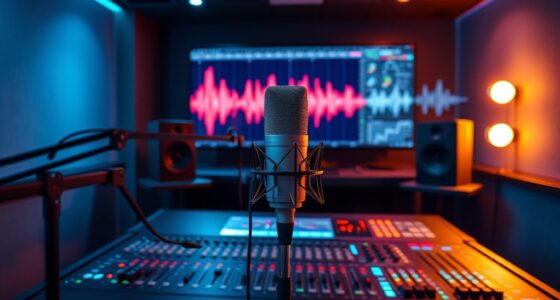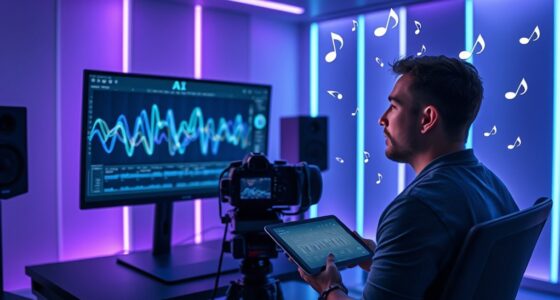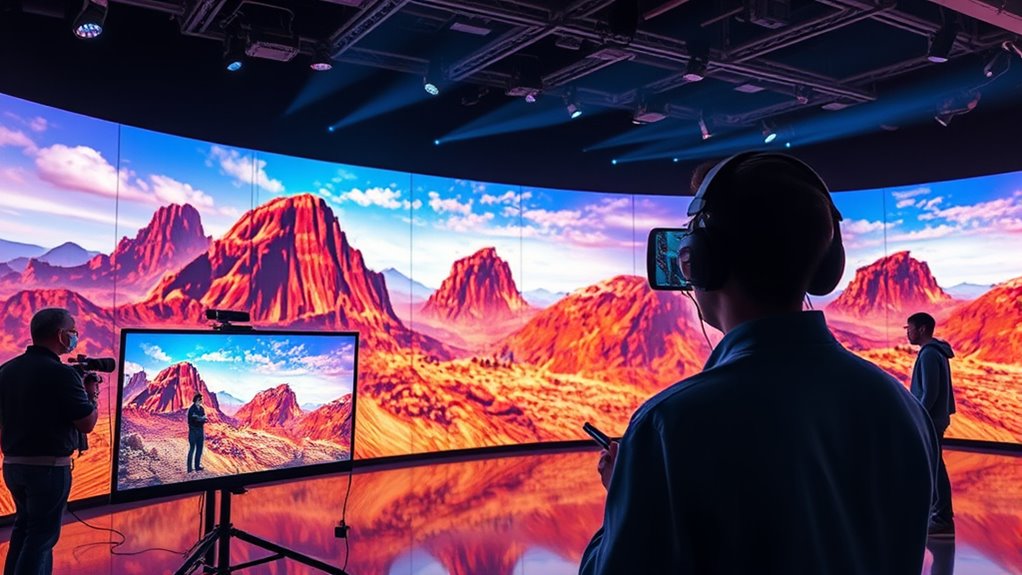

AI enhances your real-time virtual production by enabling instant rendering, so you can see your creative choices instantly. It improves motion capture, making animations smoother and more authentic with minimal effort. AI dynamically adjusts lighting and environment settings, saving you time and reducing technical glitches. This streamlines your workflow, increases efficiency, and boosts visual quality faster than ever. Keep exploring to discover how these innovations can transform your projects even further.
Key Takeaways
- AI enables instant rendering of high-quality visuals, allowing real-time visualization and rapid creative adjustments.
- It automates motion capture cleanup and translation, producing smoother, more authentic digital character animations.
- AI dynamically adjusts lighting and scene elements, ensuring consistent, realistic visuals without manual intervention.
- It accelerates production timelines by reducing technical errors and minimizing the need for multiple takes.
- AI streamlines virtual workflows, lowering costs and enhancing creative flexibility through faster, more efficient processes.
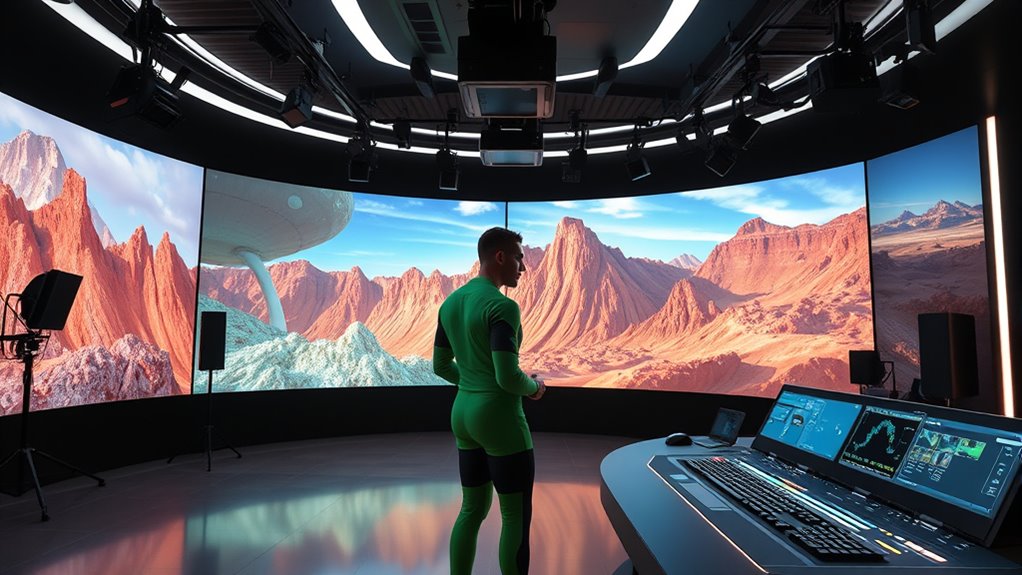
Artificial intelligence is revolutionizing virtual production by streamlining workflows and enhancing visual realism. One of the most significant ways AI does this is through real time rendering, which allows you to see the results of your creative decisions instantly. Instead of waiting minutes or hours for complex scenes to process, AI-powered systems optimize rendering processes, delivering high-quality visuals almost instantly. This rapid feedback loop enables you to make adjustments on the fly, whether you’re refining lighting, textures, or camera angles, saving you time and boosting your productivity. With real time rendering, you can experiment more freely, knowing that your changes will be reflected immediately, fostering a more dynamic and efficient creative process.
Another core component AI enhances is motion capture technology. Traditionally, capturing realistic human movement required elaborate setups and post-production fixes, often leading to delays and inaccuracies. Now, AI-powered motion capture systems can interpret and translate actors’ performances directly into digital characters with remarkable precision. These systems utilize machine learning algorithms to clean up motion data, fill in gaps, and reduce noise, resulting in smoother, more authentic animations. By automating many of the technical aspects of motion capture, AI allows you to focus more on performance and storytelling rather than technical troubleshooting. This integration accelerates the production timeline and improves the quality of the final output.
Furthermore, AI’s role in improving real time rendering and motion capture technology works hand-in-hand to create immersive virtual environments. For instance, AI can dynamically adjust lighting in real time based on scene changes or actor movements, ensuring consistent and realistic visuals without manual intervention. It can also predict and correct potential issues in motion data, reducing the need for multiple takes or extensive editing. These advancements mean you can conduct virtual shoots with fewer post-production edits, making the entire process more seamless and cost-effective. The combination of AI-driven real time rendering and motion capture technology transforms virtual production from a complicated, resource-heavy task into a more accessible and agile process, empowering you to bring creative visions to life with unprecedented speed and realism.
real-time virtual production software
As an affiliate, we earn on qualifying purchases.
As an affiliate, we earn on qualifying purchases.
Frequently Asked Questions
How Does AI Improve Virtual Set Design Efficiency?
AI improves virtual set design efficiency by streamlining virtual set optimization and enabling an AI-driven workflow. You can quickly generate, modify, and test set elements, reducing manual work and iterations. This speeds up the entire process, allowing you to focus on creativity while AI handles technical adjustments. As a result, your virtual set design becomes faster, more precise, and adaptable, enhancing overall production quality and reducing turnaround times.
Can AI Predict Real-Time Visual Adjustments During Filming?
Yes, AI can predict real-time visual adjustments during filming through predictive rendering and real-time editing. It analyzes live footage and environmental data to anticipate changes, enabling seamless updates to virtual backgrounds, lighting, and effects. This proactive approach reduces lag and enhances production flow, allowing you to respond instantly to scene changes. AI-driven predictions make virtual productions more dynamic, immersive, and efficient, giving you greater creative control during filming.
What Are Ai’s Limitations in Virtual Production Environments?
AI’s limitations in virtual production are like a double-edged sword. You might face issues like AI bias, which skews results and affects authenticity, and data privacy concerns, risking sensitive information leaks. These hurdles can hinder seamless integration and accuracy. While AI advances, you must stay vigilant, ensuring ethical use and safeguarding data, so your virtual environments remain trustworthy and realistic without falling prey to unintended biases or privacy breaches.
How Secure Is Ai-Generated Content in Virtual Production?
AI-generated content in virtual production can be quite secure if you prioritize AI ethics and data privacy. You should implement strict access controls, encrypt sensitive data, and regularly audit your systems. By staying informed about ethical guidelines and privacy regulations, you can minimize risks. Remember, maintaining transparency with your team and clients about how AI handles data helps build trust and ensures your virtual production remains protected.
What Future AI Developments Could Revolutionize Virtual Production?
Imagine a future where AI paints vivid scenes in your mind’s eye, transforming virtual production with seamless AI creative collaboration. Advances could include smarter, more intuitive tools that respect AI ethical concerns, ensuring responsible innovation. These developments will enable you to craft immersive worlds effortlessly, blending human ingenuity with AI’s precision—creating a new era where storytelling becomes limitless, and virtual environments evolve in real time with astonishing detail and authenticity.

Understanding Motion Capture for Computer Animation
As an affiliate, we earn on qualifying purchases.
As an affiliate, we earn on qualifying purchases.
Conclusion
As you leverage AI in virtual production, you’ll find it’s transforming the industry faster than ever. With real-time AI-driven rendering reducing production times by up to 30%, you’re empowered to create more dynamic, immersive experiences efficiently. This technology not only streamlines workflows but also opens new creative possibilities. Embracing AI means staying ahead in a rapidly evolving landscape, where innovation accelerates and your projects become more impressive—making the future of virtual production brighter and more exciting than ever.

CZUR Aura Pro Book & Document Scanner,Capture A3 & A4, Auto-Flatten & Deskew Powered by AI Technology, Foldable & Portable, Compatible with Windows & Mac OS
Compatibility: Work with macOS 10.13 or later AND Windows XP/7/8/10/11
As an affiliate, we earn on qualifying purchases.
As an affiliate, we earn on qualifying purchases.

Music Software Bundle for Recording, Editing, Beat Making & Production – DAW, VST Audio Plugins, Sounds for Mac & Windows PC
No Demos, No Subscriptions, it's All Yours for Life. Music Creator has all the tools you need to…
As an affiliate, we earn on qualifying purchases.
As an affiliate, we earn on qualifying purchases.