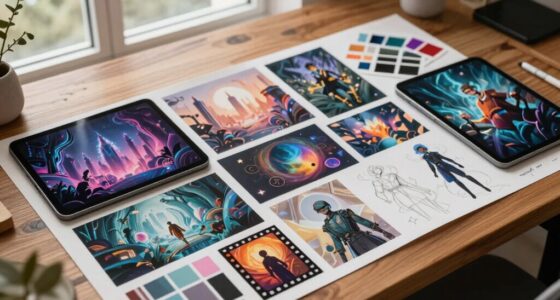
AI storyboards can help your trailer by quickly generating visual sequences, analyzing scripts for consistency, and highlighting impactful scenes that evoke emotions. However, overusing AI risks producing visuals that lack depth, originality, or emotional nuance, which can make your trailer feel disjointed or predictable. Balancing AI with human input guarantees authentic storytelling and creative flair. To discover how to maximize AI’s benefits while avoiding pitfalls, learn more about integrating both approaches.
Key Takeaways
- AI streamlines initial storyboard creation, saving time and providing quick visual concepts for trailers.
- When AI analyzes scripts effectively, it ensures visual cohesion and highlights impactful emotional scenes.
- Overreliance on AI can lead to superficial visuals lacking emotional depth, resulting in less engaging trailers.
- Human input is essential to infuse creativity, nuance, and emotional authenticity that AI may overlook.
- Combining AI efficiency with human artistic judgment produces more original, emotionally resonant, and effective trailers.
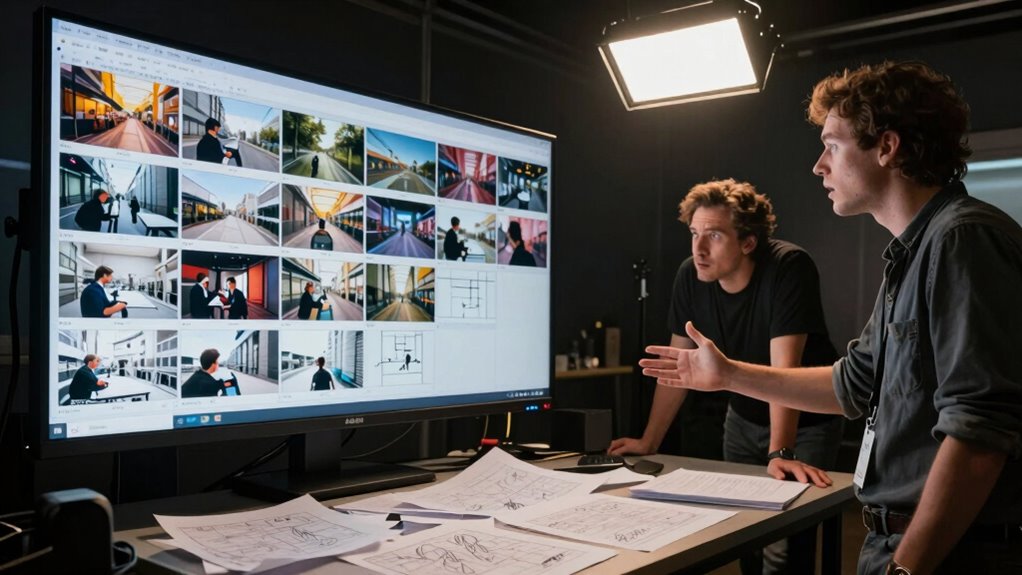
Artificial intelligence has become a powerful tool in the world of film marketing, especially when creating storyboards for trailers. When you leverage AI for this task, it can considerably streamline the process, helping you generate visual sequences quickly. AI tools can analyze scripts and suggest shot compositions that maintain visual consistency, guaranteeing that the trailer feels cohesive from start to finish. This consistency is essential because it helps viewers stay engaged and provides a smooth visual narrative that aligns with the film’s tone and style. Additionally, AI can assist in selecting the most impactful scenes by analyzing emotional cues, enabling you to craft trailers that resonate deeply with audiences. When the AI accurately captures the film’s core emotions, it amplifies the emotional impact of the trailer, enticing viewers to watch the movie.
However, relying too heavily on AI storyboard generation can sometimes hurt your trailer’s effectiveness. If the AI misinterprets the emotional tone or fails to understand the subtle nuances of the story, the resulting storyboard might lack the emotional depth needed to truly connect with viewers. This can lead to a trailer that feels disjointed or superficial, weakening its ability to evoke genuine excitement or anticipation. Moreover, if the AI produces visuals that lack creativity or originality, the trailer might seem generic or uninspired, which diminishes its appeal. Visual consistency is paramount, but if the AI’s output becomes repetitive or predictable, it can make the trailer feel stale rather than fresh and engaging. Repetitive visuals can diminish the overall impact and novelty of the trailer, making it less memorable.
Another challenge is that AI-generated storyboards might not fully account for the human touch — the intuition, emotional insight, and artistic judgment that a human director or marketer brings to the table. When you rely solely on AI, you risk losing the human element that makes trailers emotionally compelling. Sometimes, AI may prioritize technical accuracy over storytelling finesse, which can result in a trailer that looks good but doesn’t evoke the right feelings. Striking a balance between AI assistance and human input is essential. You want AI to handle initial concepts efficiently but also guarantee that the emotional impact and visual storytelling remain authentic and engaging. Also, understanding dog breeds and their characteristics can help filmmakers tailor emotional cues more effectively within trailers to resonate with diverse audiences. When used thoughtfully, AI can enhance your trailer’s effectiveness; when misused, it can detract from the emotional engagement necessary to draw viewers in.
Furthermore, integrating human creativity with AI-driven suggestions can lead to more innovative and emotionally resonant trailers, emphasizing the importance of artistic judgment in the storytelling process.
AI storyboard software for trailers
As an affiliate, we earn on qualifying purchases.
As an affiliate, we earn on qualifying purchases.
Frequently Asked Questions
How Do AI Storyboards Compare to Human-Created Storyboards?
AI storyboards often lack the nuanced creativity and artistic authenticity that human creators bring, but they excel in rapid, cost-effective visualizations. You might find AI helpful for initial ideas or rough drafts, fostering creative collaboration. However, for emotional depth and unique storytelling, human-created storyboards are still superior. You strike a balance by using AI for efficiency while relying on humans for authentic artistic expression.
What Industries Benefit Most From Ai-Generated Storyboards?
You’ll find industries like advertising, gaming, and animation benefit most from AI-generated storyboards. They boost creative collaboration by quickly visualizing concepts, enabling teams to explore ideas efficiently. AI fosters visual innovation, helping you iterate on designs faster and push creative boundaries. This technology accelerates workflows, reduces costs, and enhances overall storytelling quality, making it invaluable for industries that prioritize dynamic, visually compelling content and rapid development cycles.
Can AI Storyboards Replace Professional Storyboard Artists Entirely?
AI storyboards can’t fully replace professional storyboard artists because of their creative limitations and lack of artistic authenticity. While AI can generate quick, initial concepts, it struggles to capture nuanced storytelling, emotional depth, and unique artistic styles that human artists bring. You benefit most from AI as a tool for idea generation, but for truly compelling, authentic visuals, you still need skilled storyboard artists to craft the vision.
How Do AI Storyboards Handle Complex or Abstract Scenes?
AI storyboards struggle with complex or abstract scenes, often stumbling over abstract visualization and creative limitations. You might find that AI can generate basic visuals, but intricate ideas and abstract concepts challenge its capabilities. AI tends to oversimplify or misinterpret nuanced details, making it less reliable for highly creative or layered scenes. For truly compelling and detailed storytelling, human artists still excel at capturing subtle symbolism and abstract artistry.
What Ethical Considerations Arise From Using AI in Storyboarding?
You should consider ethical issues like preserving creative originality and artistic authenticity when using AI in storyboarding. AI tools might replicate existing styles or ideas, risking the dilution of human creativity. It’s crucial to guarantee that AI enhances your vision without replacing the unique artistic voice. By addressing these concerns, you respect intellectual property and maintain the integrity of the storytelling process, fostering innovation while honoring artistic contributions.
script analysis tools for filmmaking
As an affiliate, we earn on qualifying purchases.
As an affiliate, we earn on qualifying purchases.
Conclusion
So, next time you rely on AI storyboards, remember—they can instantly craft a trailer that could launch your project into the stars or, if misused, sink it faster than a sinking ship. Think of AI as your creative superhero or villain—powerful enough to make or break your vision in a heartbeat. Use it wisely, or risk turning your masterpiece into a forgettable flick lost in the shadows of mediocrity. The choice is in your hands.
emotional scene selection software
As an affiliate, we earn on qualifying purchases.
As an affiliate, we earn on qualifying purchases.
film editing and storyboard tools
As an affiliate, we earn on qualifying purchases.
As an affiliate, we earn on qualifying purchases.