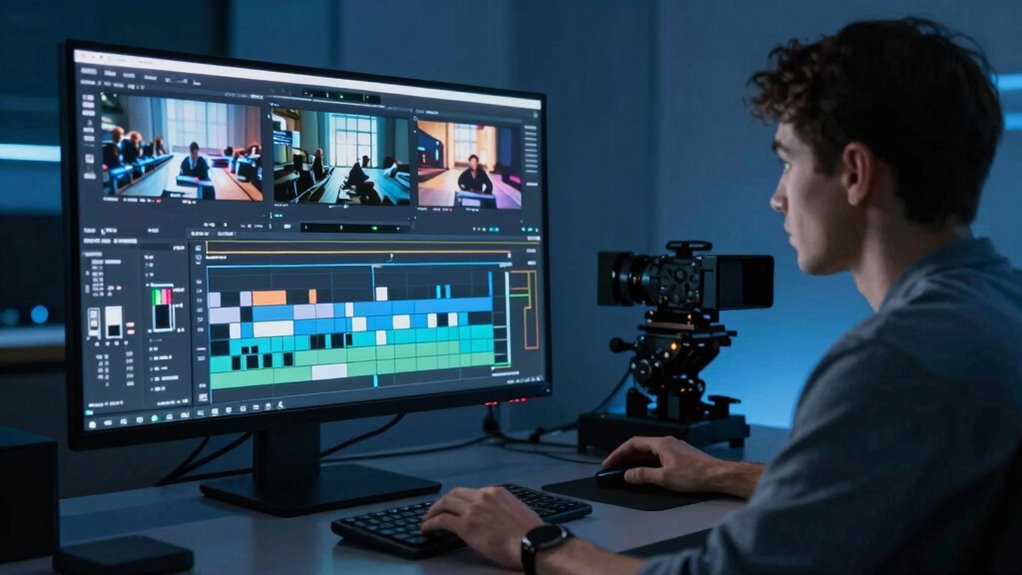

AI speeds up your rough cuts by automating tedious tasks like sorting clips, syncing audio, and detecting scenes, freeing you to focus on your creative vision. It offers intelligent suggestions for *smooth progressions*, pacing, and initial edits, acting as a helpful partner rather than a replacement. Its analytical capabilities quickly identify key shots and relevant footage, making your editing process more efficient. Stick around to discover how AI can transform your workflow even further.

Get movie-night favorites delivered free — and shop member deals
- Fast, free delivery on millions of items
- Access to Prime Big Deal Days deals on October 6–7
- Prime Video, Amazon Music and more included
Key Takeaways
- AI automates tedious tasks like sorting clips and scene detection, freeing editors to focus on creative decisions.
- It suggests initial rough cuts based on style preferences, accelerating the editing process.
- AI analyzes footage quickly to identify key scenes and best shots, reducing manual review time.
- Automated features like color correction and audio syncing streamline workflows without replacing human input.
- AI fosters creativity by enabling rapid experimentation with sequences and effects, enhancing innovation.

Artificial intelligence is revolutionizing film editing by considerably speeding up the rough cut process. As an editor, you might worry that AI could replace your role, but instead, it acts as a powerful partner that enhances your workflow. With AI collaboration, you gain tools that handle tedious tasks, freeing you to focus on the creative elements that truly require your expertise. Creative automation allows AI to sift through hours of footage rapidly, identifying key scenes, selecting the best shots, and even suggesting rough cuts based on your style preferences. This means you spend less time on the initial assembly and more time refining the story.
AI’s ability to analyze footage quickly accelerates the entire editing process. It can automatically sort clips by content, quality, or relevance, helping you locate the best takes in a fraction of the usual time. This collaboration between human insight and machine efficiency ensures that the rough cut is ready sooner, without sacrificing quality. Instead of replacing you, AI tools serve as assistants that handle repetitive tasks, enabling you to make more creative decisions faster. For example, AI-driven software can suggest transitions, pacing, and even generate preliminary edits, giving you a solid starting point to build upon.
AI sorts clips by relevance and quality, helping you find the best takes faster and enhance your creative workflow.
Creative automation extends beyond mere sorting and selecting. It can also help with audio syncing, color correction, and scene detection, streamlining multiple aspects of editing. These automated features don’t take away your control; they augment your capabilities, allowing you to focus on storytelling rather than technical chores. You remain the author of the project, but now armed with AI tools that boost your efficiency. This partnership makes it easier to meet tight deadlines and handle larger projects without feeling overwhelmed. Additionally, AI’s ability to analyze footage rapidly is enhanced by content recognition, which helps identify specific objects or themes within scenes, further speeding up the editing workflow. As machine learning algorithms continue to evolve, their accuracy improves, making the automation even more reliable over time and with increased data. Moreover, the integration of advanced algorithms ensures that the AI tools become more intuitive and adaptable to different editing styles.
Furthermore, AI collaboration fosters a new level of experimentation. You can try different sequences, effects, or pacing options easily, as AI tools can quickly generate variants based on your input. This creative automation encourages innovation and helps you explore different narrative styles without starting from scratch each time. Overall, AI doesn’t threaten your role—it amplifies your skills, making the rough cut process faster and more dynamic. When used effectively, it becomes an invaluable collaborator that transforms the way you approach film editing, ultimately helping you craft compelling stories more efficiently.
As an affiliate, we earn on qualifying purchases.
Frequently Asked Questions
Can AI Handle Complex Editing Decisions Independently?
AI can’t handle complex editing decisions independently because it lacks the nuanced understanding needed for creative collaboration. While it can suggest edits and streamline workflows, ethical considerations prevent it from fully replacing human judgment. You should see AI as a tool that supports your creative vision, helping with technical tasks and initial cuts, but ultimately, your expertise guides the project to make certain emotional depth, context, and ethical standards are maintained.
How Does AI Learn a Director’s Editing Style?
You train AI to learn your editing style by feeding it your past projects, allowing it to recognize your editing nuances. As the AI analyzes your choices, it adapts, but beware of AI bias that might skew its understanding. Continuous feedback helps refine its accuracy, ensuring it captures your unique style and minimizes bias, so the AI complements your workflow rather than replacing your creative touch.
Will AI Tools Replace Human Editors Entirely?
AI tools won’t fully replace human editors because creative collaboration and ethical considerations remain essential. You benefit from AI’s speed and efficiency, but your artistic judgment, emotional insight, and understanding of storytelling are irreplaceable. AI can assist, streamline workflows, and handle repetitive tasks, yet your unique perspective guarantees the final cut resonates. Balancing technology with human creativity maintains ethical standards and preserves the artistry behind compelling editing.
What Are the Limitations of AI in Rough Cuts?
AI in rough cuts has creative limitations, as it struggles to grasp nuanced storytelling and emotional depth. It may also reflect bias concerns, since algorithms learn from existing data, which can carry inherent biases. While AI speeds up technical editing tasks, you still need your creative judgment to shape the narrative. Rely on AI as a tool, but trust your instincts for the artistic aspects that require human insight.
How Secure Is Sensitive Footage When Using AI Software?
When using AI software for sensitive footage, you’re protected by data encryption and access control measures. These safeguards guarantee your footage remains secure from unauthorized access or breaches. You should verify that the AI provider follows robust security protocols, including end-to-end encryption and strict access controls. By doing so, you can confidently utilize AI tools, knowing your sensitive footage stays private and secure throughout the editing process.
As an affiliate, we earn on qualifying purchases.
Conclusion
Embracing AI in editing isn’t about replacing your craft but gently opening new doors for creativity. It’s like having a helpful companion that clears the path, allowing your artistry to shine brighter and faster. With AI handling the more routine tasks, you’re free to focus on the nuanced touches that truly define your vision. In this quiet collaboration, you find space to grow, ensuring your story resonates more deeply—without losing the soul only you can bring.
video editing color correction tools
As an affiliate, we earn on qualifying purchases.
As an affiliate, we earn on qualifying purchases.
audio syncing software for video editing
As an affiliate, we earn on qualifying purchases.
As an affiliate, we earn on qualifying purchases.
Fall Picks
fall essentials
As an affiliate, we earn on qualifying purchases.