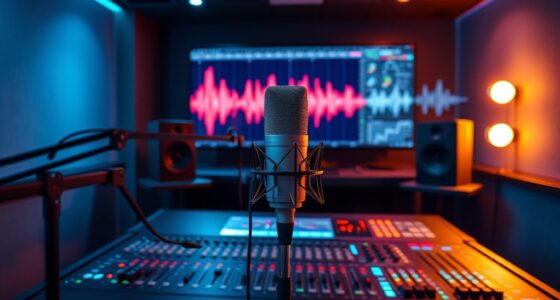
When considering AI-generated music for trailers, ethical questions arise about legality, artistic authenticity, and fair use. You need to think about who owns the rights—developers, companies, or AI itself—and whether this music truly captures emotional depth. Concerns also include the impact on human musicians and data privacy. As you explore further, you’ll discover how these issues shape the future of creative expression and industry standards.
Key Takeaways
- Ownership rights of AI-generated trailer music are unclear, raising questions about legal and ethical attribution.
- AI may lack emotional depth, potentially undermining the emotional impact crucial for effective trailer music.
- Using copyrighted training data without proper consent raises ethical concerns about intellectual property rights.
- Reliance on AI could devalue human musicianship and threaten artistic diversity in trailer soundtracks.
- Industry must balance technological efficiency with respecting artistic integrity and audience emotional expectations.

As the entertainment industry seeks innovative ways to captivate audiences, AI-generated music for trailers is rapidly gaining traction. This technology offers a quick, cost-effective way to produce compelling soundtracks that can heighten anticipation and emotional impact. However, as you explore this frontier, you must consider the ethical questions it raises, especially around copyright concerns and artistic authenticity. When AI creates music, questions about who owns the rights—whether it’s the developer, the company, or the AI itself—become increasingly complex. Copyright concerns emerge because traditional legal frameworks are often ill-equipped to handle works generated by algorithms. This ambiguity can lead to disputes over intellectual property, especially if AI-produced music closely resembles existing compositions or if multiple entities claim rights over the same piece. Steering these legal waters demands clarity and new standards that recognize AI’s role in creative processes.
Beyond legal issues, you also need to think about artistic authenticity. Music has long been recognized as a deeply personal form of expression, rooted in human emotion and experience. When trailers rely on AI-generated tracks, some argue that the emotional depth and nuance may be diminished because algorithms lack genuine human insight. While AI can mimic styles and produce technically impressive music, it may fall short in capturing the subtle imperfections, spontaneous creativity, or cultural context that human artists bring to their work. This raises questions about whether AI-created music can truly evoke the same emotional response from audiences or if it simply offers a sanitized, formulaic alternative. As a creator or producer, you might grapple with whether relying on AI undermines the artistic authenticity of your project or if it simply represents a new tool in your creative arsenal.
Furthermore, there’s an ongoing debate about the role of human musicians in an age dominated by AI. Some see AI as a means to democratize music creation, allowing those without access to traditional training to generate soundtracks. Others worry that it could devalue the craft, leading to a homogenization of music and a loss of unique artistic voices. Additionally, the ethical implications extend to how privacy and data management are handled when AI models are trained on vast datasets, which can include copyrighted material. As you weigh these considerations, keep in mind that ethical use of AI in trailer music isn’t just about legality; it’s also about preserving the integrity and emotional authenticity that audiences have come to expect. Finding a balance between leveraging cutting-edge technology and respecting artistic traditions will be paramount as AI-generated music becomes more prevalent in the entertainment industry.
AI music composition software
As an affiliate, we earn on qualifying purchases.
As an affiliate, we earn on qualifying purchases.
Frequently Asked Questions
Can AI Fully Replace Human Composers in Trailer Music?
AI can’t fully replace human composers in trailer music because it lacks creative authenticity and emotional depth. While AI can generate impressive tracks, it often misses the nuanced artistry that comes from human experience. You benefit most from artistic collaboration, where AI tools enhance your creativity rather than supplant it. Human touch ensures the music resonates emotionally, capturing the trailer’s essence and engaging viewers on a deeper level.
How Does Ai-Generated Music Influence the Emotional Impact of Trailers?
AI-generated music heightens emotional authenticity, boosts audience engagement, and amplifies the trailer’s impact. It adapts quickly to different scenes, creating a personalized emotional experience. You notice how the music resonates deeply, guiding your feelings and enhancing anticipation. By effectively aligning melodies with visuals, AI influences your emotional response, making trailers more memorable and immersive. This power to shape emotions can transform how you connect with the story before it even begins.
Are There Legal Restrictions on Using Ai-Created Music in Commercial Trailers?
Yes, there are legal restrictions on using AI-created music in commercials. You need to address intellectual property rights and licensing challenges, as AI-generated music may still be subject to copyright laws. You must guarantee proper licensing or ownership rights, otherwise, you risk legal disputes. Always verify whether the AI platform grants rights for commercial use and consider consulting legal experts to navigate potential intellectual property issues.
Who Owns the Rights to Ai-Generated Trailer Music?
You own the rights to AI-generated trailer music if the process involves your input and control, as it reflects your creative originality. However, if an AI tool creates the music independently, the intellectual property rights can become complex, often depending on the tool’s licensing terms and jurisdiction. In such cases, the rights may belong to the creator of the AI or the platform, not necessarily the user.
Can AI Learn to Create Culturally Sensitive or Diverse Musical Themes?
Ironically, AI can learn to create culturally sensitive and diverse musical themes, but only if it’s fed enough authentic data. You might think it’s simple, yet achieving true cultural authenticity and diversity inclusion remains complex. AI algorithms can analyze patterns to incorporate various musical elements, but they still lack the nuanced understanding of cultural context. So, yes, AI can help, but human oversight’s essential to guarantee genuine respect and representation.
trailer music production tools
As an affiliate, we earn on qualifying purchases.
As an affiliate, we earn on qualifying purchases.
Conclusion
As you consider the rise of AI-generated music for trailers, one question lingers: what happens when creativity is no longer uniquely human? Will the lines between original art and machine-made sound blur, or will ethical boundaries protect genuine artistry? The future of trailer music hangs in the balance—are you prepared to face the implications? The choices you make now could shape the soundtrack of tomorrow’s storytelling, and the real story has just begun.
copyright free trailer music
As an affiliate, we earn on qualifying purchases.
As an affiliate, we earn on qualifying purchases.
emotional trailer soundtrack
As an affiliate, we earn on qualifying purchases.
As an affiliate, we earn on qualifying purchases.