TL;DR
European game union members published a manifesto on Nov. 16 urging workers to avoid generative AI, employers to reject it, players to support games made without it and regulators to require consent and fair compensation for training data. The text reflects the unions’ position; it is not clear how many workers they represent or whether studios will change their policies.
The document, titled “On Generative AI Usage in the Games Industry,” appeared on the website of IWGB Game Workers, the games branch of the UK union IWGB. The page says IWGB members wrote it in collaboration with members of Game Workers Unite Ireland, CSVI in Spain and the FIOM-CGIL Milan Work Council. Rock Paper Shotgun and Kotaku also identify France’s STJV and Germany’s GDRT among the signatories or participating unions, bringing the reported total to six.

Get movie nights delivered free with Prime
- Fast, free delivery on millions of items
- Prime Video, Amazon Music and more included
- Member-only deals all year
The manifesto addresses four groups. It asks workers to avoid genAI services where possible, organize and negotiate company agreements. Employers are urged to avoid generative AI entirely, ensure no worker is required to use it and precisely label any use the authors consider unavoidable. Players are asked to support games made without genAI, while regulators are urged to require consent and fair compensation before anyone’s work is used in training data, with a right for workers to withdraw their work.
The union position covers both content players see, such as art, sound, code and dialogue, and behind-the-scenes work such as concept art, reference material and pre-translation. The authors say genAI is harming workers and games, citing concerns including job replacement, pressure to use tools, fewer junior roles, disputed use of creative work in training data, discrimination and cultural homogenization. These are claims and arguments made by the manifesto, not independently established findings in the source material.
Pressure on Studios and Hiring
The manifesto turns opposition to genAI into a workplace and consumer issue, calling for company agreements and public support for games made without the tools. Its scope includes development processes that may never be visible in a finished game, so studios could face scrutiny even when AI-generated material does not appear in the final product.
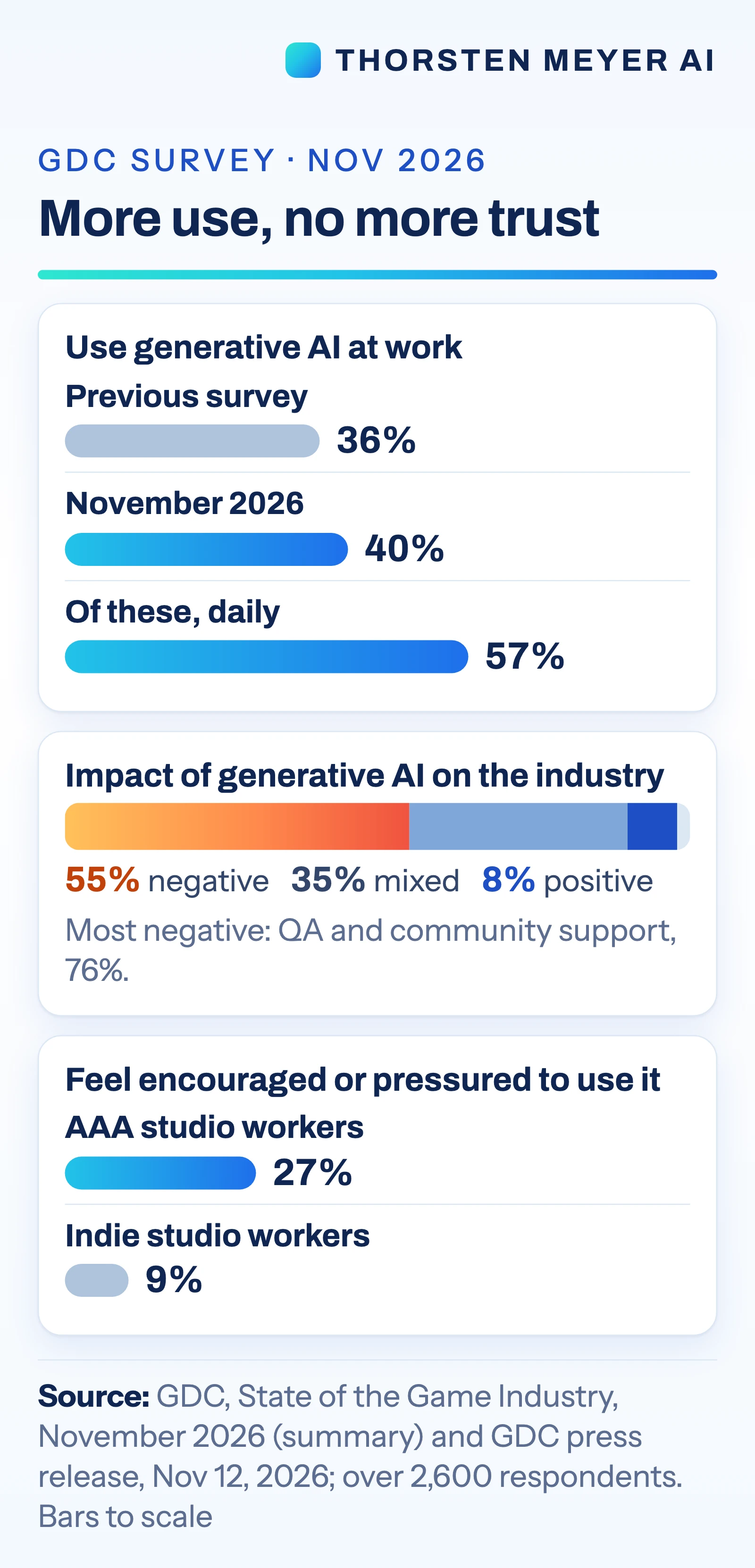
The call comes amid mixed signals from the workforce. The Game Developers Conference’s Nov. 12 industry survey found that 40% of respondents used generative AI at work, up from 36% in the prior survey, while 55% said it was having a negative effect on the industry. The survey also reported that 34% had been laid off in the previous two years. Those figures describe respondents and do not establish that AI caused the layoffs.
For studios, the debate touches both labor relations and how games are marketed. A demand to label AI use precisely could make production choices more visible to players, while the unions’ call for consent and compensation places data practices and creative ownership at the center of the dispute.
Popular right now

De'Longhi Rivelia Automatic Espresso Machine with Milk Frother

Apple AirPods Pro 3 Wireless Earbuds with Active Noise Cancellation

De'Longhi Magnifica Duo Fully Automatic Espresso Machine with Milk Frother, Silver
As an affiliate, we earn on qualifying purchases.
A Wider Industry Dispute
The manifesto was published during a period of public disagreement over genAI in game development. The GDC survey, released four days before the unions’ statement, reported both rising workplace use and significant concern among developers about the technology’s effects.
Days before publication, a group of Independent Games Festival jurors said they would not vote for games using genAI “in any capacity,” according to the source material. The studio behind Big Walk also disclosed that large language models touched “well under 0.1%” of its code. That disclosure concerns one studio and does not indicate how common such use is across the industry.
Industry representatives have expressed a different outlook. Video Games Europe, the European trade body, wrote in 2024 that genAI was widely expected to take game development to the next level and argued against AI labels in games. On Nov. 12, Xbox CEO Asha Sharma said a small team would be able to build worlds that now require hundreds of developers, though she did not name AI in the statement cited here.
““Games are best made by people.””
— The manifesto’s authors
Representation and Studio Response
The source material does not say how many workers the participating unions represent, whether any studio plans to follow the recommendations or whether employers have responded privately. It reports no public response from a studio or trade body to the manifesto by the time of writing.
The relationship between generative AI and job losses also remains unresolved here. The GDC survey’s figure that 34% of respondents had been laid off in the previous two years does not identify AI as the cause. The unions argue that genAI is replacing workers and reducing junior opportunities, but the material does not provide a separate measurement establishing the scale of either effect.
The legality of using third-party work to train AI models is also disputed, according to the source. The manifesto describes such data as stolen; that is the unions’ characterization, not a settled legal finding presented in the material.
Negotiations and Industry Adoption
The manifesto urges workers to organize and seek company agreements covering when and how generative AI can be used. Any resulting studio policies, negotiations or labeling practices would show whether the statement changes workplace rules; the source material identifies no announced follow-up dates or commitments.
Regulators may also face pressure over consent, compensation and withdrawal rights for work used in AI training. The manifesto states the unions’ requested protections but does not point to a specific legislative timetable. Further responses from studios, trade bodies or lawmakers would clarify whether the dispute leads to policy changes or remains a public campaign.
Key Questions
What are the European game unions asking studios to do?
The manifesto asks employers to avoid generative AI entirely, never require workers to use it and precisely label any use the authors consider unavoidable.
Does the manifesto cover AI used behind the scenes?
Yes. Its scope includes early development work such as concept art, reference material and pre-translation, as well as assets that appear in games.
Does the GDC survey show that AI caused game industry layoffs?
No. It reported that 34% of surveyed professionals had been laid off in the previous two years, but the source material does not connect those layoffs to AI.
How many workers do the unions represent?
The source material does not state the number of workers represented by the participating unions.
Have studios responded to the manifesto?
No public response from a studio or trade body was identified in the source material by the time of writing.
Source: Thorsten Meyer AI