Exploring generative tools for concept art allows you to create diverse and stunning visuals quickly. These tools help visualize ideas, develop character designs, and explore different styles, saving you hours of initial sketches. They leverage AI to mimic various art styles and produce multiple variations for refinement. While they democratize art creation, it’s important to contemplate ethical and legal aspects. If you want to discover how to harness their full potential responsibly, keep exploring these innovative techniques.
Key Takeaways
- Generative tools accelerate concept visualization by quickly producing diverse styles, variations, and foundational sketches for art projects.
- They enable exploration of different artistic styles, from hyper-realistic to abstract, enhancing visual fidelity and project alignment.
- Ethical considerations include respecting intellectual property, transparency about AI use, and understanding legal implications of generated art.
- These tools democratize concept art creation, allowing artists with limited resources to produce professional visuals while maintaining artistic integrity.
- Best practices involve transparency about AI involvement, verifying personal artistic voice, and staying informed on evolving AI art regulations.
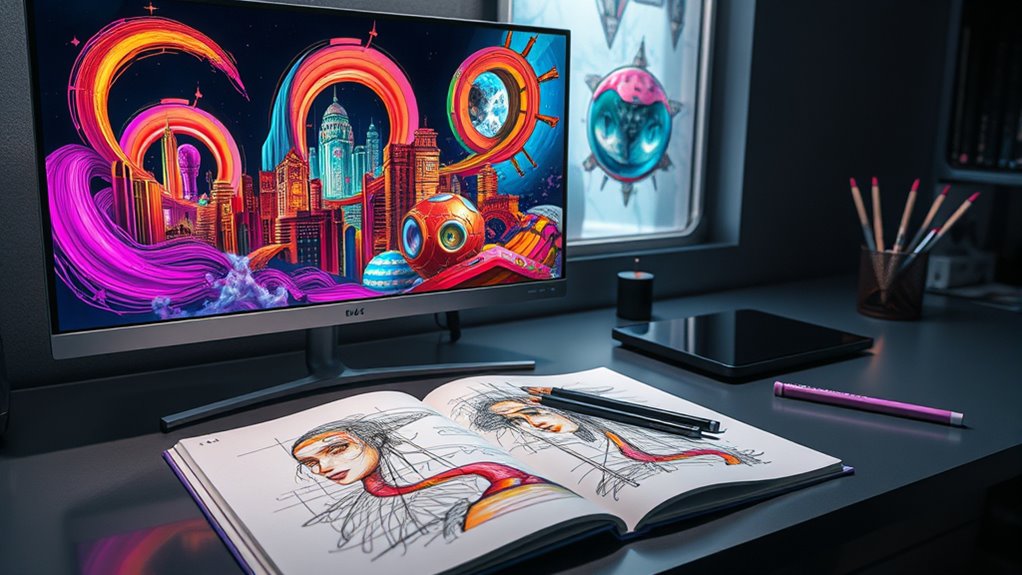
Generative tools are revolutionizing the way concept artists create and visualize their ideas. These advanced systems harness AI art styles to generate stunning, diverse visuals that can serve as a foundation or inspiration for your projects. With just a few prompts or inputs, you can produce a wide array of concepts, from character designs to environment sketches, markedly speeding up your creative process. These tools analyze vast datasets of art, enabling them to mimic various styles, from hyper-realistic to abstract, giving you endless options to explore. As a result, you no longer need to spend hours sketching initial ideas; instead, you can generate multiple variations quickly and refine the ones that resonate most with your vision. Additionally, understanding the importance of color accuracy in visual fidelity can help ensure your generated concepts are realistic and compelling. However, as you integrate generative tools into your workflow, you should also consider ethical considerations that come with their use. Many AI models are trained on existing artwork, raising questions about originality and intellectual property rights. It’s important to respect the work of other artists and be transparent about how you use AI-generated content, especially if you plan to commercialize your designs. Some artists worry that reliance on AI might devalue traditional skills or lead to a homogenization of visual styles, where unique artistic voices risk getting overshadowed by algorithmic outputs. On the other hand, these tools can democratize art creation, allowing artists with limited technical skills or resources to produce professional-quality concepts. Striking a balance between leveraging AI’s capabilities and maintaining artistic integrity is vital. Moreover, you should stay informed about the evolving legal landscape surrounding AI art. Laws regarding copyright, attribution, and the ethical use of AI-generated content are still developing, and being proactive will help you avoid potential legal pitfalls. When sharing or selling AI-assisted work, it’s advisable to clearly communicate the role of generative tools in your creative process. This transparency not only aligns with ethical practices but also fosters trust with clients and audiences. Remember, while AI can be a powerful partner in your creative journey, it’s essential to maintain your artistic voice and verify that your work reflects your unique perspective. By thoughtfully integrating AI art styles and considering ethical considerations, you can harness the full potential of generative tools while respecting the broader artistic community. This approach will help you stay innovative, responsible, and true to your craft as you explore new horizons in concept art.
Top picks for "explor generative tool"
As an affiliate, we earn on qualifying purchases.
Frequently Asked Questions
How Do Generative Tools Impact Traditional Concept Art Workflows?
Generative tools considerably impact your traditional concept art workflows by enabling AI collaboration, which accelerates idea generation and iteration. These tools seamlessly integrate into your workflow, allowing you to quickly explore concepts, refine details, and experiment with different styles. As a result, you save time, boost creativity, and focus more on refining your vision, making your process more efficient and innovative without replacing the core skills of traditional concept art.
What Are the Best Free Generative Tools Available for Beginners?
Think of AI collaboration as a trusty sidekick guiding your creative journey. For beginners, free tools like DALL·E Mini, Artbreeder, and Deep Dream Generator serve as your launchpad, transforming ideas into vivid visuals with ease. These platforms enable creative automation, letting you focus on your vision while the tool handles the heavy lifting. plunge in, experiment, and watch your concept art flourish without breaking the bank.
Can Generative Tools Create Fully Detailed Concept Art?
Generative tools can create highly detailed concept art, but AI creativity has its limits. You might get impressive results, but often, the output lacks full refinement or originality. Tool limitations mean you’ll still need to add personal touches and adjustments to achieve your vision. So, while these tools are great for inspiration, they aren’t usually capable of producing completely finished, detailed concept art on their own.
How Do Artists Maintain Originality Using Generative AI?
To maintain originality using generative AI, you focus on authenticity preservation and creative inspiration. You customize prompts, tweak outputs, and combine AI-generated ideas with your personal style. By actively guiding the tool and adding your unique touches, you guarantee your work stays true to your vision. This approach helps you leverage AI as a collaborative partner, fostering fresh ideas while preserving your artistic voice.
What Are the Ethical Considerations of Using AI in Concept Art?
When you use AI in concept art, you must consider ethical issues like AI bias and intellectual property. For example, if an AI model is trained on copyrighted images without permission, it raises legal and moral questions. Additionally, biases in AI can lead to stereotypes or misrepresentation. You should verify fair use, respect original creators, and be transparent about AI’s role to address these ethical concerns effectively.
Conclusion
As you delve into these generative tools, remember you’re wielding the brush of modern Da Vincis, shaping worlds with a click. Just as the alchemist sought transformation, you’re transforming blank canvases into vivid concepts faster than ever. Embrace the power, but stay mindful of your unique vision—tools are guides, not masters. In this new era, your creativity is the true magic, turning algorithms into art just like the great mythic creators of old.