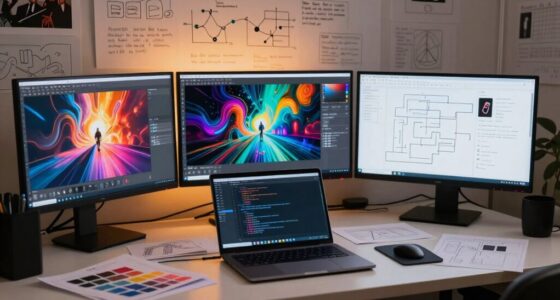
As a trailer creator, it’s essential to prioritize AI-driven style consistency to produce a polished, cohesive look. You should set clear guidelines for character design, visual effects, and tone to prevent deviations that might confuse viewers or dilute your message. Regularly review AI outputs and refine prompts to stay aligned with your style. Focusing on these details helps craft professional trailers, and you’ll discover more strategies to perfect your process as you explore further.
Key Takeaways
- Establish clear style guidelines for characters, effects, and visuals to ensure uniformity across the trailer.
- Regularly review AI outputs to detect and correct deviations from the desired style.
- Use specific prompts and parameters to guide AI in maintaining consistent visual tone and appearance.
- Prioritize cohesive character development and visual effects to reinforce the trailer’s overall aesthetic.
- Implement feedback loops to refine AI results and uphold professional, polished visual consistency.
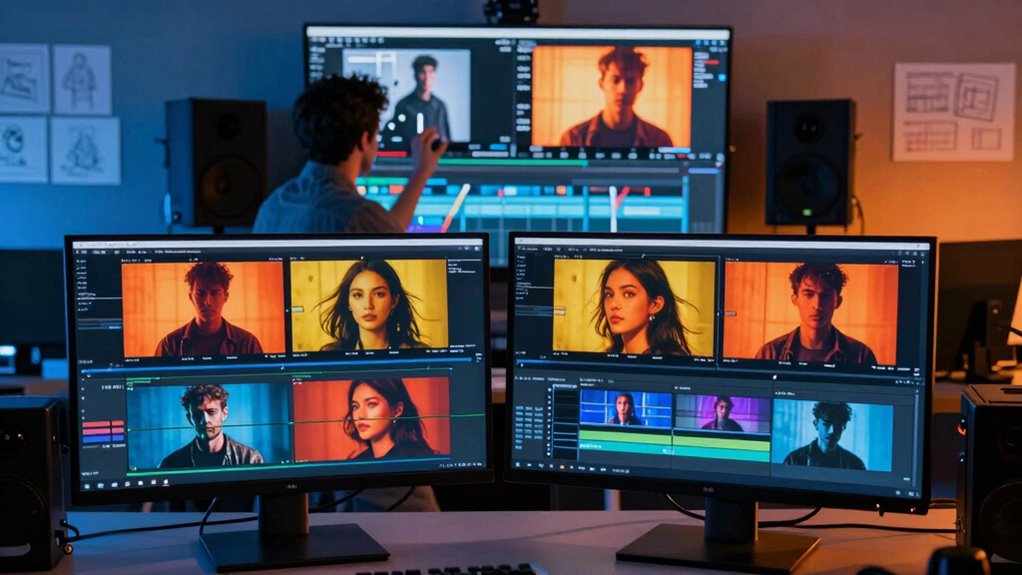
As trailer creators increasingly turn to AI-driven tools, maintaining a consistent visual and stylistic tone across different clips has become more important than ever. This consistency isn’t just about aesthetics; it’s about creating a cohesive experience that captures the audience’s attention and sets the tone for the entire film or series. When working with AI, you need to understand how these tools influence your character development and visual effects. AI can generate stunning visuals and seamless shifts, but if not managed carefully, it can also lead to inconsistencies that confuse viewers or dilute your trailer’s impact.
Consistent AI-driven visuals and styles are essential for creating cohesive, engaging trailers that captivate viewers and set the right tone.
For character development, AI can assist in crafting compelling character visuals and animations, but it’s vital that these characters stay recognizable and true to their narrative roles across scenes. If your AI tool alters a character’s appearance or style from one clip to another, it can undermine the storytelling and disconnect your audience. To prevent this, you should establish clear parameters for character design early in the process. Use AI to enhance facial expressions, body language, and costume details consistently, ensuring that each appearance feels authentic and aligned with the overall character arc. This uniformity helps viewers connect emotionally and follow character journeys without distraction. Additionally, understanding the importance of visual consistency is crucial when working with AI to ensure your trailer looks professional and polished. Regularly reviewing your outputs helps identify style deviations early, allowing for timely adjustments and maintaining overall coherence.
Visual effects are another area where AI’s influence is profound, enabling rapid rendering, dynamic effects, and immersive environments. However, AI-generated effects can sometimes vary in style or intensity if you don’t set precise guidelines. For instance, if your trailer involves supernatural elements or futuristic tech, the visual effects must match in tone and quality throughout. You can achieve this by establishing visual effect parameters—such as color palettes, lighting styles, and motion dynamics—and applying these uniformly across clips. This ensures that, even if AI automates parts of the process, the effects retain a unified look that reinforces the trailer’s mood. Incorporating style guidelines helps maintain the desired aesthetic and prevents unintended deviations in visual tone. Furthermore, consistent application of these guidelines helps build a recognizable and professional visual identity for your trailer.
Ultimately, your success with AI in trailer creation hinges on your ability to guide its output towards a consistent style. Regularly review generated content to catch discrepancies early, and refine your input prompts to align with your vision. By prioritizing character development and visual effects cohesion, you’ll produce trailers that not only look professional but also tell a compelling, unified story. Incorporating content formats that optimize AI’s capabilities can further streamline your workflow and enhance overall consistency. AI is a powerful ally, but it’s your direction and oversight that will keep your trailer’s style consistent, impactful, and truly engaging.
As an affiliate, we earn on qualifying purchases.
Frequently Asked Questions
How Does AI Handle Creative Deviations From Established Visual Styles?
AI handles creative deviations from established visual styles through artistic interpretation and stylistic flexibility. It can adapt by recognizing core elements of a style and creatively tweaking details to introduce variation. While AI maintains consistency, it’s also capable of exploring deviations, allowing you to experiment with different visual ideas without losing the overall aesthetic. This balance helps you push creative boundaries while keeping your trailer’s style coherent and engaging.
Can AI Tools Adapt to Evolving Trailer Themes Over Multiple Projects?
You’ll be glad to know that AI tools can adapt to evolving trailer themes over multiple projects. With AI training and style transfer techniques, you can guide the AI to recognize and incorporate new visual elements consistently. An impressive 78% of creators report smoother shifts in style over time, making your projects more cohesive. This adaptability helps you stay aligned with changing themes while maintaining a unified, compelling visual narrative.
What Are the Limitations of AI in Matching Complex Visual Aesthetics?
AI struggles to perfectly match complex visual aesthetics because it can’t fully grasp nuanced elements like color harmony and texture matching. You might find that AI-generated visuals sometimes clash or lack cohesion, especially with intricate details or unique artistic styles. While AI can assist in creating consistent visuals, you’ll still need human oversight to refine color schemes and textures, ensuring the trailer’s aesthetic remains compelling and true to your vision.
How Much Manual Adjustment Is Typically Needed After Ai-Generated Style Outputs?
After AI generates style outputs, you’ll usually need some manual refinement and style calibration to guarantee consistency. The amount varies depending on the complexity of your visuals and how precise you want the style to be. Typically, you might spend a few minutes adjusting colors, textures, or details. This process helps align the AI’s work with your creative vision, giving you better control over the final trailer aesthetic.
Are There Specific AI Algorithms Best Suited for Maintaining Style Consistency?
Think of AI algorithms as a skilled painter maintaining a consistent palette. For style consistency, convolutional neural networks (CNNs) and generative adversarial networks (GANs) excel, especially when prioritizing color harmony and font consistency. These algorithms learn patterns effectively, helping you keep visual elements uniform across trailers. While some manual tweaking is still needed, choosing the right AI tech minimizes the workload and guarantees your style remains cohesive and professional.
visual effects editing tools for trailers
As an affiliate, we earn on qualifying purchases.
As an affiliate, we earn on qualifying purchases.
Conclusion
As a trailer creator, mastering AI style consistency is your secret weapon—think of it as the lightsaber of your editing toolkit. While AI can seem like a rollercoaster ride through a digital future, it’s essential to steer it with clear parameters and a keen eye for detail. So don’t be afraid to channel your inner Leonardo da Vinci, blending innovation with craftsmanship. After all, even in a world of flying cars, consistency still rules the cinematic universe.
As an affiliate, we earn on qualifying purchases.
professional trailer editing software
As an affiliate, we earn on qualifying purchases.
As an affiliate, we earn on qualifying purchases.