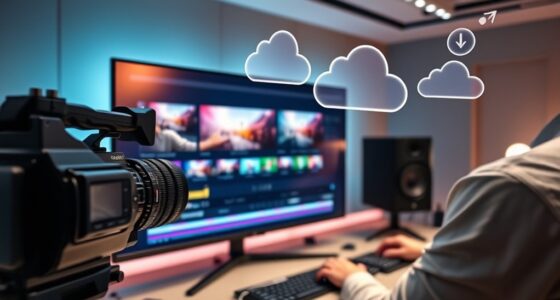

Quantum computing could dramatically transform VFX by providing immense processing power to handle complex simulations and rendering tasks faster than ever before. It enables real-time rendering of highly detailed scenes and ultra-realistic visual effects, pushing current hardware limits. Although hardware challenges like qubit stability remain, ongoing research promises to open new possibilities. If you keep exploring, you’ll discover how this emerging technology might soon become a essential tool in creating stunning visuals.
Key Takeaways
- Quantum computing enables faster processing of complex simulations, making highly detailed VFX rendering more feasible.
- It allows real-time rendering of intricate scenes, drastically reducing production times and enhancing visual realism.
- Quantum algorithms can solve specific problems exponentially faster, expanding creative possibilities in visual effects.
- Hardware challenges like qubit stability and error correction currently limit practical quantum VFX applications.
- Future advancements could revolutionize VFX workflows, enabling ultra-realistic visuals beyond current technological constraints.
Quantum computing is beginning to revolutionize visual effects (VFX) by offering unprecedented processing power that can handle complex simulations and rendering tasks far faster than traditional computers. This leap in capability largely hinges on the development of quantum algorithms, which are specially designed to leverage the unique principles of quantum mechanics. These algorithms can solve certain problems exponentially faster than classical algorithms, making tasks like realistic fluid dynamics, particle systems, and light simulations more feasible within shorter timeframes. As a VFX artist or engineer, you could soon see quantum algorithms enabling real-time rendering of highly detailed scenes, something that currently takes hours or even days with conventional hardware. However, harnessing this potential isn’t without its hurdles.
One major challenge lies in the hardware itself. Quantum computers require extremely delicate and precise hardware to operate effectively. Unlike classical computers that use bits, quantum computers rely on qubits, which are highly sensitive to environmental disturbances such as temperature fluctuations, electromagnetic noise, and vibration. These hardware challenges mean that maintaining qubit coherence over time is difficult, often resulting in errors during calculations. As a result, current quantum hardware is prone to noise and instability, limiting the complexity and size of problems it can handle reliably. For VFX applications, this means that until hardware challenges are addressed, quantum computers may only be suitable for specific tasks or as part of hybrid systems that combine classical and quantum processing. Advances in qubit stability are crucial for unlocking broader applications in the field.
Overcoming these hardware challenges requires innovation in qubit design, error correction, and system stability. Researchers are exploring various physical implementations, like superconducting circuits, trapped ions, and topological qubits, each with its own pros and cons. Error correction techniques are also advancing, aiming to reduce the impact of noise and extend qubit coherence times. This progress is essential because it will determine when quantum computers can move from experimental prototypes to practical tools for VFX workflows. As these technical barriers diminish, you could find yourself using quantum-enhanced software to create ultra-realistic visuals that are currently impossible or take impractical amounts of time.
quantum computing hardware for VFX
As an affiliate, we earn on qualifying purchases.
As an affiliate, we earn on qualifying purchases.
Frequently Asked Questions
How Soon Will Quantum Computing Be Accessible to VFX Studios?
Quantum computing will likely become accessible to VFX studios within the next five to ten years, as quantum integration advances and hardware becomes more affordable. You’ll see improvements in VFX scalability, allowing you to handle complex simulations and rendering faster than ever. While widespread adoption may take time, early access through cloud-based quantum services will enable your studio to experiment and benefit from this transformative technology sooner.
What Are the Main Technical Challenges in Applying Quantum Computing to VFX?
You face main technical challenges like quantum decoherence, which causes qubits to lose information quickly, and the need for advanced error correction methods to maintain stability. These issues make it difficult to perform complex VFX calculations reliably. Overcoming them requires developing more robust qubits and efficient error correction techniques, so quantum computers can handle the demanding tasks in VFX production without errors or data loss.
Can Current Quantum Hardware Handle Complex VFX Rendering Tasks?
Currently, your quantum hardware can’t handle complex VFX rendering tasks effectively. Achieving Quantum Supremacy remains a challenge due to noise in qubits, which hampers reliable calculations. Noise mitigation techniques are essential to improve stability. While progress is promising, existing quantum computers still lack the necessary qubit count and error correction needed for demanding VFX rendering. You’ll need more advanced, noise-resilient systems before tackling such intricate visual effects.
How Does Quantum Computing Compare to Classical Computing in VFX Workflows?
Quantum computing offers significant advantages over classical computing in VFX workflows by leveraging entanglement benefits and advanced quantum algorithms. You can process complex simulations and rendering tasks faster, reducing time and resource costs. While classical systems handle most current VFX work, quantum algorithms enable solving specific problems more efficiently, paving the way for more realistic effects and innovative visual experiences in the future.
What Training Is Needed for VFX Artists to Use Quantum Computing Tools?
Did you know that 70% of VFX artists believe adapting to new tech is vital? To use quantum computing tools, you’ll need to develop quantum literacy—understanding quantum principles and algorithms. Additionally, training in software integration is essential to seamlessly incorporate quantum solutions into your workflows. This involves hands-on courses, tutorials, and collaboration with experts to guarantee you can effectively harness quantum power for VFX innovations.
Real-Time Rendering, Fourth Edition
As an affiliate, we earn on qualifying purchases.
As an affiliate, we earn on qualifying purchases.
Conclusion
As you explore the future of VFX, quantum computing could revolutionize how you create complex simulations, like realistic water or smoke effects. Imagine a studio where rendering those effects takes minutes instead of hours, freeing you to focus on creativity. For example, a hypothetical case shows how a blockbuster film’s visual scenes could be produced faster and more realistically. Embracing quantum tech might just be the game-changer your projects need to stand out in the industry.

Quantum Computing: From Concepts to Code
As an affiliate, we earn on qualifying purchases.
As an affiliate, we earn on qualifying purchases.
Quantum Error Correction
As an affiliate, we earn on qualifying purchases.
As an affiliate, we earn on qualifying purchases.